You don't need the "right" job to join a good credit union.
Credit unions publish open-membership pathways: partner associations, foundations and open charters that anyone can use. Many pay the joining fee for you. Here's how the pathways work, and six credit unions to know.
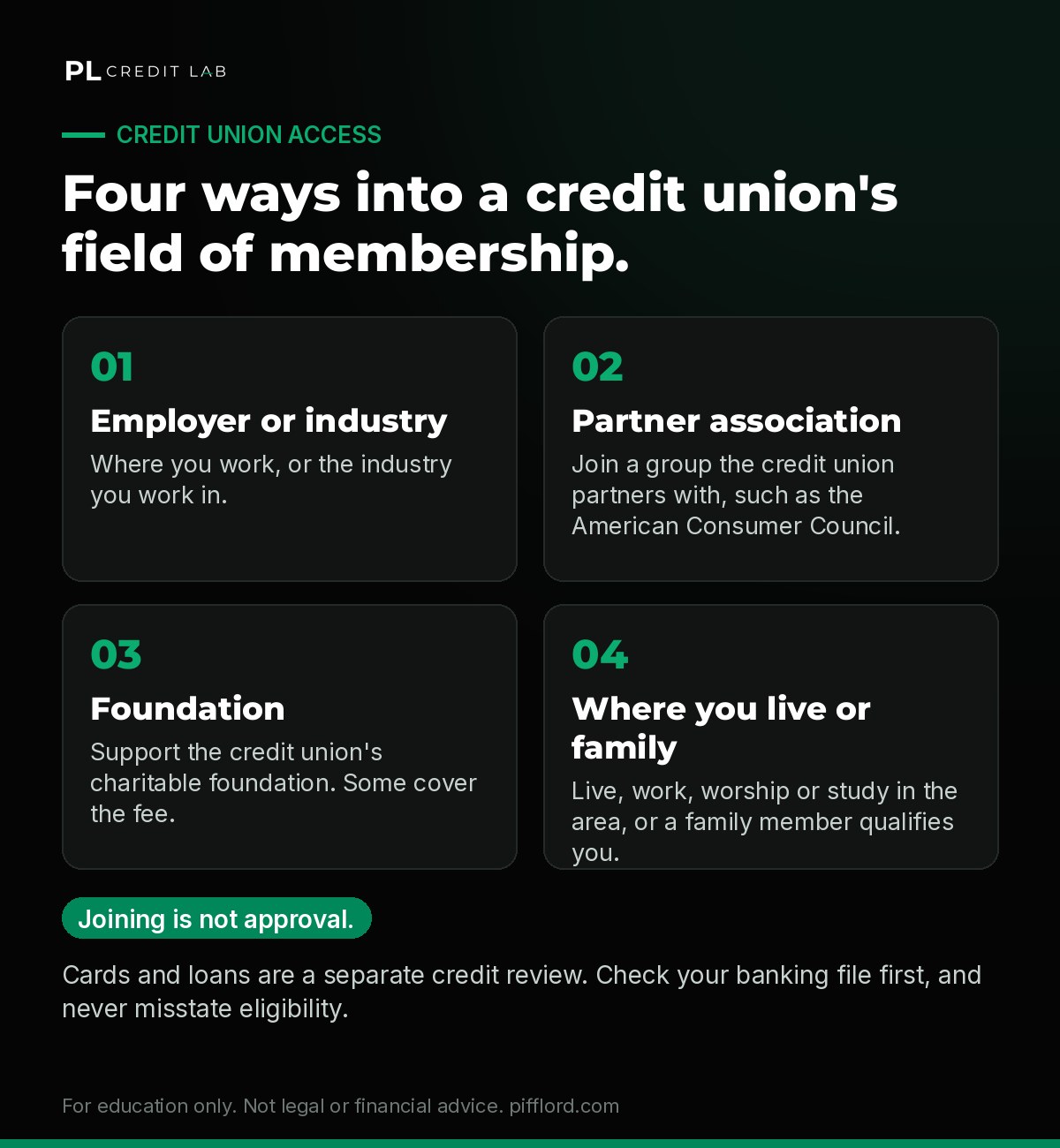
Every credit union has a field of membership.
That's the legal list of who can join. Most people only know the employer route. There are others.
Join a partner group. Join a consumer or nonprofit association the credit union partners with. The American Consumer Council is the best-known one.
Support its foundation. Some credit unions let you join through their own charitable foundation, and several cover the small fee themselves.
Open, local or family. A few are open to anyone. Others serve everyone who lives, works, worships or studies in an area, such as New York City, or a family member can qualify you.
What it is, and why credit unions use it.
A consumer-education membership organization founded in 1987. Its own site charges $15 for a lifetime individual membership, but partner credit unions usually waive or pay that for you.
Pick it on the application
Choose the American Consumer Council as your eligibility.
You're enrolled
The credit union enrolls you in the council.
Open the share account
Often $5, then the credit union's identity and banking-file checks.
Four rules.
Check your banking file
Credit unions screen ChexSystems or Early Warning. A negative record can block the account.
Joining isn't approval
Cards and loans are a separate credit review.
Open savings only
Decline overdraft lines when you join; some credit unions pull credit for those.
Never misstate eligibility
These are published rules, not loopholes.
Checked on each credit union's own website, October 15, 2026.
Where we have reliable data on which credit bureau a credit union pulls for cards and loans, it's shown.
Andrews Federal Credit Union
American Consumer Council, enrolled automatically, no fee. $5 base share savings. Bureau pulled: not published.
United Federal Credit Union
American Consumer Council; United pays the dues while you're a member. Any individual in the U.S. Bureau pulled: not published.
Hudson Valley Credit Union
HVCU Charitable Foundation for residents of NY, NJ, CT, MA, PA and VT; the credit union covers the fee. Bureau pulled: not published.
Alliant Credit Union
Alliant Credit Union Foundation; Alliant pays the $5 fee. Nationwide. Bureau pulled: usually TransUnion (limited data).
PenFed Credit Union
Open membership, no military tie needed. $5 savings share. Bureau pulled: usually Equifax or TransUnion (limited data).
Municipal Credit Union
Live, work, worship or attend school in NYC, or family of a member. Bureau pulled: not published.
Rules change. Confirm eligibility on the credit union's website before applying. Bureau data comes from consumer-reported data points and varies by state and product. PL Credit Lab is not affiliated with any credit union listed.
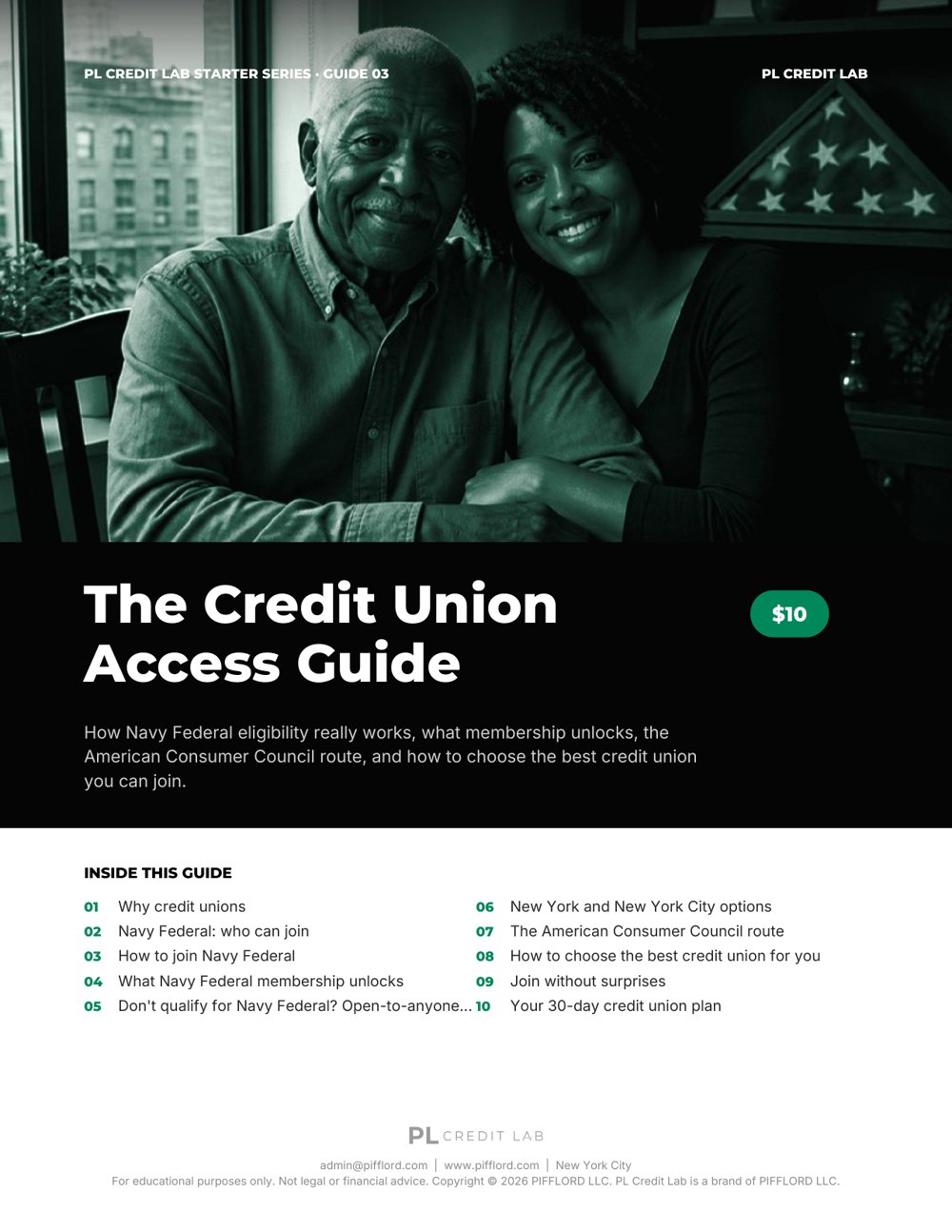
The Credit Union Access Guide.
How Navy Federal eligibility really works, including the family route most people never check, the American Consumer Council route, and how to choose the best credit union you can join.
Includes the founder's own Navy Federal story, a decision path and a step-by-step join checklist.
Membership is not approval. PL Credit Lab provides education and makes no promises about approvals, credit limits, scores, deletions, timelines or funding amounts.
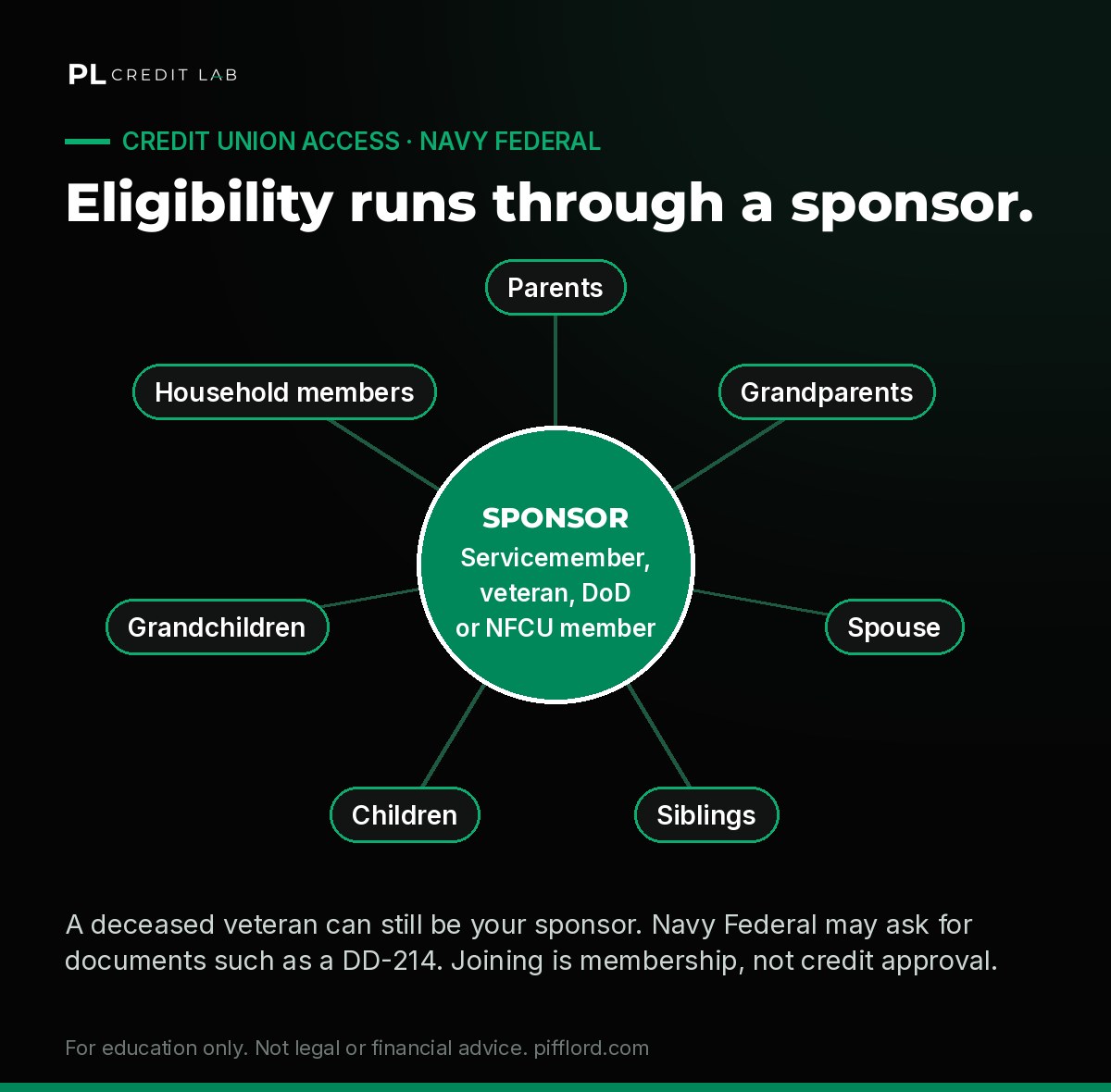
Join Navy Federal through family.
Parents, grandparents, siblings, children, grandchildren and household members can all sponsor you, even a veteran who has passed.